Monday, March 24, 2014

Medical Mnemonics - Causes of Papillary Necrosis - "POSTCARDS"

Internal Medicine Board Review and Medical Mnemonics for Causes of Papillary Necrosis - POSTCARDS
Mnemonic for causes of Papillary Necrosis _ “POSTCARDS”
It’s Medical Mnemonics Monday!

Renal Papillary Necrosis is a form of nephropathy characterized by coagulative necrosis of the renal medullary pyramids and papillae.  Causes of Papillary Necrosis can be remembered by the mnemonic “POSTCARDS”.
  • Pyelonephritis
  • Obstruction of the urogenital tract
  • Sickle cell disease
  • Tuberculosis
  • Chronic liver disease,
  • Analgesia/alcohol abuse,
  • Renal transplant rejection
  • Diabetes mellitus
  • Systemic vasculitis
Check out the list of the previous Medical Mnemonics here.

Saturday, March 22, 2014

Internal Medicine Board Review: Causes of Microcytic Anemia (“TICS”)


MARCH 17, 2014 
Medical Mnemonics for Internal Medicine Board Review Concept - Microcytic Anemia "TICS"
Medical Mnemonics – Causes of Microcytic Anemia – “TICS”
It’s Medical Mnemonics Monday!

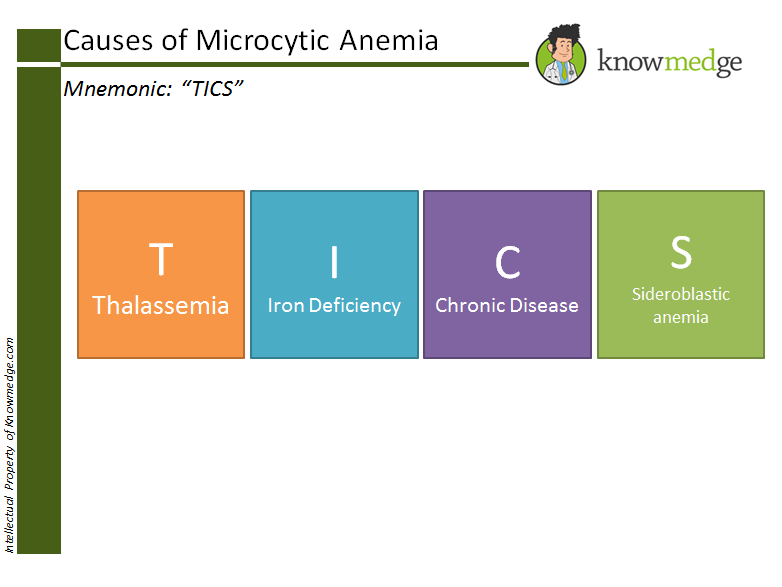
Microcytic anemia is defined as “the presence of small, often hypochromic, red blood cells in a peripheral blood smear and is usually characterized by a low MCV.” One of the most popular and well known medical mnemonics is “TICS” – used to remember the causes of microcytic anemia.
  • T – Thalassemia
  • I – Iron Deficiency
  • C – Chronic Disease
  • S – Sideroblastic anemia
Check out the list of the previous Medical Mnemonics here.

Monday, March 3, 2014

Medical Mnemonics: Antiobiotics contraindicated during Pregnancy

Medical Mnemonics: Antibiotics contraindicated in pregnancy can be remembered by the mnemonic "MCAT"
Medical Mnemonics: Antibiotics Contraindicated in Pregnancy

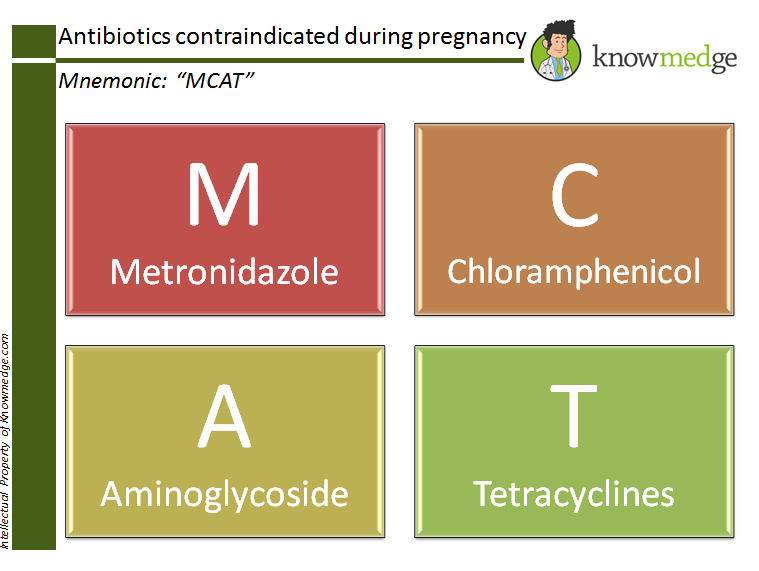
Antibiotics contraindicated in pregnancy are important to know and understand. They can be remembered by a simple mnemonic “MCAT”
  • M – Metronidazole
  • C – Chloramphenicol
  • A – Aminoglycoside
  • T – Tetracyclines
Check out the list of the previous Medical Mnemonics here.

Monday, February 17, 2014

Medical Mnemonics - Recognizing Features of Melanoma - "ABCDE"

Features of Melanoma can be recognized by the mnemonic ABCDE
Medical Mnemonics – Features of Melanoma

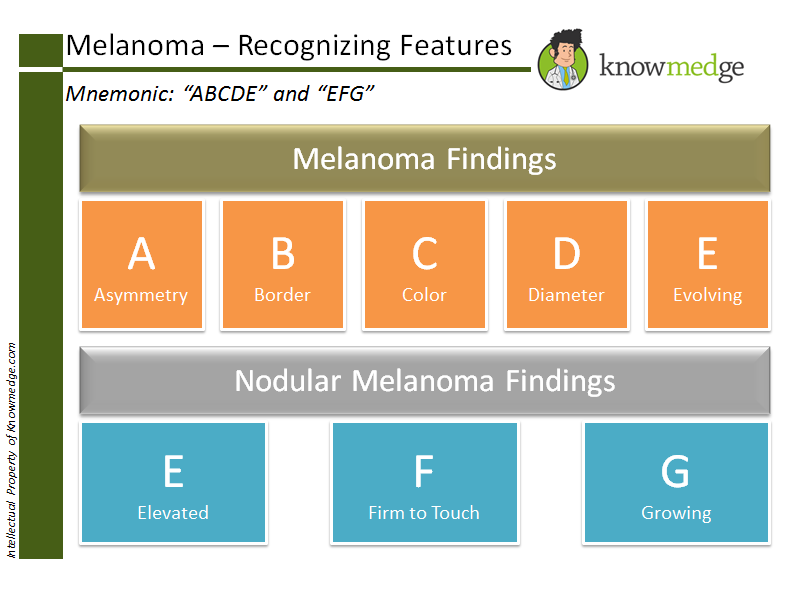
Medical mnemonic for the recognizing features of Melanoma It is important to recognize the moles and growths that might cancerous early in the process. A mole exhibiting the following ABCDE features should be at least suspected for Melanoma.
  • A: Asymmetry – Asymmetric moles are particularly suspicious
  • B: Border – Irregular borders are more likely to be cancerous
  • C: Color – Different colors within a mole are suspicious
  • D: Diameter – Moles with a diameter > 6mm are especially suspicious
  • E: Evolving – A mole that is enlarging or begins to feel itchy is another suspicious sign
A special distinction is made for Nodular Melanoma, which is often smaller in size and symmetrical. It is also often even in color. The mnemonic EFG is often used for the recognizing features of Nodular Melanoma.
  • E: Elevated
  • F: Firm to touch
  • G: Growing progressively for more than a month
Check out the list of the previous Medical Mnemonics here.

Monday, February 10, 2014

Medical Mnemonics: Causes of Anion Gap Metabolic Acidosis – “GOLD MARK”

Causes of Anion Gap Acidosis can be remembered by the mnemonic "GOLD MARK" - Previously "MUDPILES"

Medical Mnemonics – Anion Gap Acidosis – “GOLD MARK”

The classic mnemonic often used to remember the causes of anion gap metabolic acidosis is “MUDPILES”
  • M – Methanol
  • U – Uremia
  • D – Diabetic ketoacidosis
  • P – Propylene Glycol
  • I – Isoniazid
  • L – Lactic Acidosis
  • E – Ethylene Glycol
  • S – Salicylates
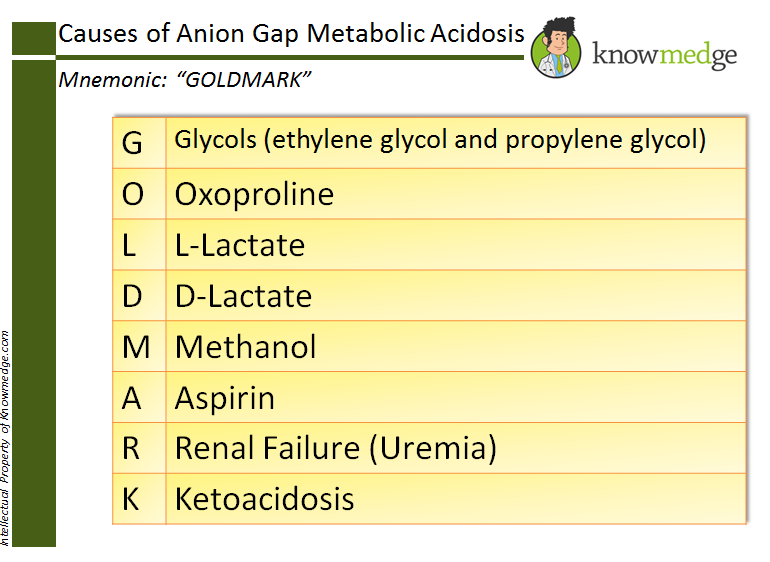
More recently a new mnemonic has been suggested to update new our understanding of anion-gap generating acids. The updated mnemonic “GOLD MARK” was proposed in a 2008 article in The Lancet.
  • G – Glycols (ethylene glycol and propylene glycol)
  • O – Oxoproline
  • L – L-Lactate
  • D – D-Lactate
  • M – Methanol
  • A – Aspirin
  • R – Renal Failure
  • K – Ketoacidosis
As medicine evolves, so do our Mnemonics. This is the fifth medical mnemonic in our series of Monday Mnemonics.

Monday, February 3, 2014

Medical Mnemonics: Features of Horner's Syndrome

Medical Mnemonics for Internal Medicine Board Review / USMLE Prep - "SAMPLE"
Medical Mnemonics: Features of Horner’s Syndrome – “SAMPLE”

Medical Mnemonics
Horner’s Syndrome (Oculosympathetic paresis) is a rare neurologic condition whose symptoms and signs include:
  • Ptosis (drooping eyelid)
  • Anhidrosis (inability to sweat).
  • Miosis (pupil constriction)
Horner’s syndrome can be caused by any set of sympathetic nerve fiber injuries. Horner’s syndrome is generally classified into Central and Peripheral.
  • Central: Sympathetic nerves start in the brain and then travel down to the spinal cord and into the chest.
  • Peripheral: Sympathetic nerves start from the chest to the neck, arteries, head, and into the eyes.
Another feature of Horner’s syndrome is loss of ciliospinal reflex (pupil dilates when pressure / pain applied to neck or face. Patients with Horner’s syndrome also experience Enophthalmos (posterior displacement of the eyeball). These features can all be remembered by the mnemonic “SAMPLE”
  • S: Sympathetic Nerve Fiber Injury
  • A: Anhidrosis
  • M: Miosis
  • P: Ptosis
  • L: Loss of ciliospinal reflex
  • E: Enophthalmos

Monday, January 27, 2014

Medical Mnemonics: Symptoms of Kawasaki Disease


Medical Mnemonic for Kawasaki Disease – “CREAM”

Kawasaki disease (mucocutaneous lymph node syndrome) is a rare childhood disease that causes inflammation in the walls of small-sized and medium sized arteries. It is most often seen in children under the age of 5 of Asian descent (primarily Japanese of Korean). It is somewhat more common in boys than girls.

There is no known cause for this disease and it is not contagious.

There is no single test for Kawasaki disease and in order to diagnose it, you must look for symptoms. The symptoms and criteria for diagnosis can be remembered by the mnemonic “CREAM”. The criteria defined for diagnosis is that the child must have fever for greater than 5 days and must show four of the following five symptoms.
  • C: Conjunctivitis (non-exudative)
  • R: Rash (polymorphous non-vesicular)
  • E: Edema (or erythema of hands or feet)
  • A: Adenopathy (cervical, often unilateral)
  • M: Mucosal involvement (erythema or fissures or crusting)
This is the fourth in our series of Medical Mnemonics Monday posts. You can all previous Knowmedge medical mnemonics posts.